discoDSP Schroeder reverb 1.0 AU-VST3 MacOS [免费]
Modeled reverb based on Schroeder reverberator. Overview Early Schroeder reverberators consisted of the following elements: ■ A series connection of several all-pass filters. ■ A parallel bank of feedback comb filters. ■ A mixing matrix. The all-pass filters provide colourless high-density echoes
资源介绍
FREE | 12 July 2020| 1.7 MB
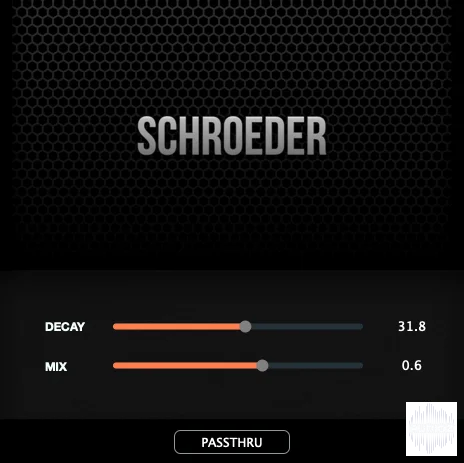
Modeled reverb based on Schroeder reverberator.
Overview
Early Schroeder reverberators consisted of the following elements:
■ A series connection of several all-pass filters.
■ A parallel bank of feedback comb filters.
■ A mixing matrix.
The all-pass filters provide colourless high-density echoes in the late impulse response of the reverberator. These all-pass filters may also be referred to as diffusers. While all-pass filters are colourless in theory, perceptually, their impulse responses are only colourless when they are extremely short (less than 10 ms or so). Longer all-pass impulse responses sound similar to feedback comb-filters. For steady-state tones, however, such as sinusoids, the all-pass property gives the same gain at every frequency, unlike comb filters.
The parallel comb-filter bank is intended to give a psychoacoustically appropriate fluctuation in the reverberator frequency response. A feedback comb filter can simulate a pair of parallel walls, so one could choose the delay-line length in each comb filter to be the number of samples it takes for a plane wave to propagate from one wall to the opposite wall and back.
Thus, one may choose the comb-filter delay-line lengths more or less arbitrarily, and then use enough of them in parallel (with mutually prime delay-line lengths) to achieve a perceptually adequate fluctuation density in the frequency-response magnitude. In four such delays are chosen between 30 and 45 ms, and the corresponding feedback coefficients are set to give the desired overall decay time.